Search This Blog

Friday, October 5, 2012

Mitt Romney agrees with you

[This is totally awesome. -egg
PS -- video, too!]
Mitt Romney agrees with you: Use the RoboRomney service to fill in your positions on issues from abortion to the economy to gun-control, and the system will mine a database of real Romney quotes to produce a position paper in which the candidate agrees with everything you say.


Special reading, Brooklyn

Whiteboard doodle

Music Appreciation: Global Bass

[Nice short intro to the notion of Global Bass/Tropical Bass with some handy links. -egg]

Sent to you via Google Reader

Music Appreciation: Global Bass


It's midnight, early August, Toronto, 2012 in a hall on the waterfront. On the stage behind large stacks of computers and gear, three large, serene dudes that go by the name A Tribe Called Red bounce up and down as they play a ferocious remix of their track "Indigenous Power" made by Monterrey, Mexico based producer Javier Estrada, along with a stream of rap, dancehall, cumbia and miscellaneous unknown vicious
styles. The video projectors show a montage of cut ups of Hollywood Native cliches interspersed with traditional symbols and electric design. It's a
hip-hop party, it's an "Electric Pow Wow", to use the name of the group's party night in Ottawa; it's
21st century cosmopolitanism in full effect: a perfect example of the bringing together of
worlds that is Global Bass.


Global Bass (a.k.a transnational bass or sometimes tropical bass) is probably most familiar to the world via the work of UK MC of Sri Lankan descent M.I.A.
and her sometime collaborator, US DJ and producer Diplo who on tracks like "Bucky Done Gun"
created a wildly successful sonic collage of digital dancehall styles from around the world, topped off with an anti-globalization rhetoric that celebrated
the dancehall pleasures of subaltern populations around the world. While commercially and artistically successful, MIA and Diplo have also been intensely
criticized for the cultural theft of styles
which do not belong to them, and for a vacuous political rhetoric which ultimately goes no further
than a feelgood sentiment of opposition which fits neatly into the marketplace for all things alternative and independent.


Beneath that story however is a thriving scene or rather group of networked scenes which is both global and bassed in very interesting and ever evolving
ways. At its core, global bass is two different things: first, the local production of electronic/digital dance musics around the world that are
i...

Thursday, October 4, 2012

5 Reasons Humanity Is Terrible at Democracy | Cracked.com

http://www.cracked.com/article_19086_5-reasons-humanity-terrible-at-democracy.html?page=full

Chirp sends information from one smartphone to another, using electronic birdsong

Chirp sends information from one smartphone to another, using electronic birdsong:

[Video Link] Nicolas Pergola of Chirp says


We're a spinout from University College London Computer Science and we've developed a new data transfer application for smartphones (and more) called Chirp.

This is our thing - a technology inspired by birdsong and the principles of biomimicry.

We think it's pretty exciting since the app has great potential, although it's just the tip of the iceberg. Our plans include teaching the machines to sing.


Wednesday, October 3, 2012

Awesomest. Video. Ever ever ever.


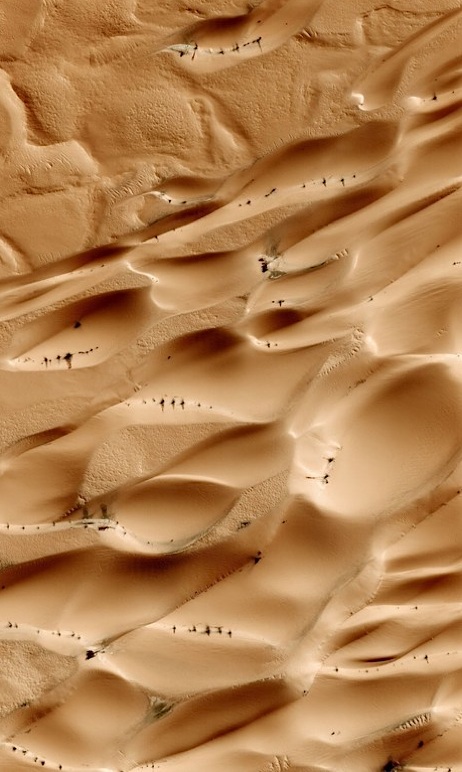
The weird, black, spidery things of Mars


Sent to you via Google Reader

The weird, black, spidery things of Mars


See those weird, black, spidery things dotting the dunes in this colorized photo taken by the Mars Reconnaissance Orbiter in 2010? Yeah. Nobody knows what the hell those things are.


What we do know about them just underlines how incredibly unfamiliar Mars really is to us. First spotted by humans in 1998, these splotches pop up every Martian spring, and disappear in winter. Usually, they appear in the same places as the previous year, and they tend to congregate on the sunny sides of sand dunes — all but shunning flat ground. There's nothing on Earth that looks like this that we can compare them to. It's a for real-real mystery, writes Robert Krulwich at NPR. But there are theories:


Scientists from the U.S. Geological Survey, from Hungary, from the European Space Agency have all proposed explanations; the leading one is so weird, it's transformed my idea of what it's like to be on Mars. For 20 years, I've thought the planet to be magnificently desolate, a dead zone, painted rouge. But imagine this: Every spring, the sun beats down on a southern region of Mars, morning light melts the surface, warms up the ground below, and a thin, underground layer of frozen CO2 turns suddenly into a roaring gas, expands, and carrying rock and ice, rushes up through breaks in the rock, exploding into the Martian air. Geysers shoot up in odd places. It feels random, like being surprise attacked by an monstrous, underground fountain.


"If you were there," says Phil Christensen of Arizona State University, "you'd be standing on a slab of carbon dioxide ice. All around you, roaring jets of carbon dioxide gas are throwing sand and dust a couple hundred feet into the air." The ground below would be rumbling. You'd feel it in your spaceboots.


Read the rest of Robert Krulwich's post — and check out some spectacular photos of the things — at NPR


Todd Akin on the scourge of doctors giving abortions to non-pregnant women


Sent to you via Google Reader

Todd Akin on the scourge of doctors giving abortions to non-pregnant women


[Video Link] Salon: Among "abortionists," Akin said in a floor speech in 2008, "you find that along with the culture death go all kinds of other lawbreaking: the not following good sanitary procedure, giving abortions to women who aren't actually pregnant, cheating on taxes, all these kinds of things." Later in the video Akin also accuses death culture doctors of killing imaginary unicorns.


Quadcopters playing catch


Sent to you via Google Reader

Quadcopters playing catch


The ETH Zurich quadcopter folks have added to their already impressive collection of videos of cooperative, autonomous quadcopters doing exciting things (previously) with this video of the adorable little gizmos throwing and catching balls together.


To toss the ball, the quadrocopters accelerate rapidly outward to stretch the net tight between them and launch the ball up. Notice in the video that the quadrocopters are then pulled forcefully inward by the tension in the elastic net, and must rapidly stabilize in order to avoid a collision. Once recovered, the quadrotors cooperatively position the net below the ball in order to catch it.


Because they are coupled to each other by the net, the quadrocopters experience complex forces that push the vehicles to the limits of their dynamic capabilities


Cooperative Quadrocopter Ball Throwing and Catching - IDSC - ETH Zurich


(via JWZ)


Tuesday, October 2, 2012

Ask science: Does sugar really make children hyper?


Sent to you via Google Reader

Ask science: Does sugar really make children hyper?


"Why aren't my kids hyper after binging on sugar?" asked Gillian Mayman at Mind the Science Gap, a blog featuring the work of various Master of Public Health students from the University of Michigan.


The punchline: "A review of 12 separate research studies found that there was no evidence that eating sugar makes kids hyper."


The post is great, but greatest of all? The animated GIFs used to illustrate it. (via @Boraz)


Monday, October 1, 2012

Mitt Romney’s Leniency Toward Corporate Welfare Queens : The New Yorker

http://m.newyorker.com/talk/financial/2012/10/08/121008ta_talk_surowiecki

Aerial Photographs of Volcanic Iceland by Andre Ermolaev

Aerial Photographs of Volcanic Iceland by Andre Ermolaev:
Aerial Photographs of Volcanic Iceland by Andre Ermolaev landscapes Iceland
At first glance these photos by Andre Ermolaev look like twisting abstract paintings, but in reality are aerial photos of rivers flowing through Iceland’s endless beds of volcanic ash. Given its name and stereotypical depiction it’s somewhat surprising to learn that the small country named after ice is home to no less than 30 active volcanic systems. You’ll remember the eruption of the massive Grímsvötn volcano just last year that spewed some 120 million tons of ash in the first 48 hours and snarled air traffic for days. Of his photographs Ermolaev says:
Iceland is a wonderful country; I would even say that it is a true paradise for all the photo shooting-lovers. But what has become a real discovery for me is the bird’s eye view of the rivers flowing along the black volcanic sand. It is an inexpressible combination of colors, lines, and patterns. The photo represents the mouth of the river falling into the ocean. [...] A little bit upstream there is a yellow-colored brook flowing into the river, but yellow currents fail to mix with the main water flow. One can estimate the scale judging by the car tracks that are clearly seen on the black sand. This is just a river, just a volcano, just our planet.
You can see much more of his work over on 500px. (via my modern met)

Guerrilla Grafters covertly add fruit-tree branches to ornamental trees


Sent to you via Google Reader

Guerrilla Grafters covertly add fruit-tree branches to ornamental trees


The Guerrilla Grafters are a group of rogue artists who roam San Francisco, covertly grafting fruit-tree branches onto ornamental trees to create a municipal free lunch. John Robb calls it "resilient disobedience."


How can you improve the productivity of your community even if the officials are against it?


One way is through resilient disobedience. For example, there's a group of gardeners in San Francisco that are spreading organic graffiti across the city. How? By grafting branches from fruit trees onto ornamental trees that have been planted along sidewalks and in parks.


They are using a very simple tongue in groove splice that's held together with annotated electrical tape. Good luck to them.


Personal Biochar Kilns, Portable Factories, DiY Septic Tank Cleaning, and Guerrilla Grafting

(via Warren Ellis)


Black American sign language and American sign language are different languages


Sent to you via Google Reader

Black American sign language and American sign language are different languages

I've been fascinated by the history and development of sign language for a while now. Highly linked to local Deaf cultures, individual sign languages have deep roots in the home-made systems people came up with in order to communicate with one another and with their families at times when Deaf people were often a lot more socially isolated than they are today. That means that each sign language is unique — even British and American sign language aren't at all the same thing. English is spoken in both countries, but the cultural history that gave birth to sign was sufficiently different to produce two completely different languages that are unintelligible to one another. (Meanwhile, American sign language is much closer to French, because it also has roots in a system imported from France in the 19th century.)


In that case, it was a physical distance that lead to the development of two different sign languages. But, within the United States, the same thing happened because of social distance. Turns out, there is a Black American sign language that is distinctly different, as a language, from ASL. Its roots lie in segregation, and especially in separate-and-not-at-all-equal school systems. Ironically, though, that meant sign language had a more prominent place in black schools for much of the 20th century. At white schools, up until the 1970s and 1980s, students were heavily pressured to speak and lip-read, rather than sign — because it was thought to be better. Meanwhile, at black schools, sign language continued to be heavily used, growing and changing. By the late 1960s, the two systems were almost completely different languages.


Carolyn McCaskill remembers exactly when she discovered that she couldn't understand white people. It was 1968, she was 15 years old, and she and nine other deaf black students had just enrolled in an integrated school for the deaf in Talledega, Ala.


... The teacher's quicksilver hand movements looked little like the sign language McCaskill had grown up using at home with her two deaf siblings and had practiced at the Alabama School for the Negro Deaf and Blind, just a few miles away. It wasn't a simple matter of people at the new school using unfamiliar vocabularly; they made hand movements for everyday words that looked foreign to McCaskill and her fellow black students.


...So, McCaskill says, "I put my signs aside." She learned entirely new signs for such common nouns as "shoe" and "school." She began to communicate words such as "why" and "don't know" with one hand instead of two as she and her black friends had always done. She copied the white students who lowered their hands to make the signs for "what for" and "know" closer to their chins than to their foreheads. And she imitated the way white students mouthed words at the same time as they made manual signs for them.


Turn your personal mob into an army


Sent to you via Google Reader

Turn your personal mob into an army


The startup team behind Human.io.

Human.io is the new thing from Joshua Schachter, founder of bookmarking site del.icio.us. This time, however, he's not suggesting you share your travels with a few friends—he's suggesting that you turn them into an army.

"If you want to build a flash mob, but have it actually do something useful, this is your API," Schachter said. "It lets you invite your audience to become part of the action."

The concept—developed by Paul Rademacher, creator of legendary Craigslist/Google Maps mashup Housingmaps, and Nick Nguyen, formerly of Yahoo and Mozilla—is straightforward enough: Human.io is a platform for performing "micro-tasks".

First, you publish a simple, crowdsourceble activity, such as voting on something, going to a particular location, or taking photos—anything that might be accomplished with a smartphone's UI and its sensors. Then you tell your readers, followers or friends about it. They start the app, get cracking, and, finally, the results are sent back to you.


Human.io can be scripted in Python and PHP, languages easy enough for laypeople to create basic tasks, but powerful enough to set up more complex and rewarding interactions. Writes Schachter: "missions and activities to get people involved more directly than just reading stuff on a screen."

To illustrate how the platform works, Human.io developed an app for us aimed at benefiting the Creative Commons, and Wiki Loves Monuments in particular: wikipedia.human.io.

The idea is to help Wikipedia's project to improve public access to photography of the world's architectural and local heritage. If you want to participate, install the free Human.io app (iOS, Android) and select the "Photograph a historic place" task. It'll cough up a list of anything nearby that's in the online encyclopedia's monument hit list. All you have to do is head out, take a shot, and let Human.io do the rest. It'll show up immediately at wikipedia.human.io, released under the Creative Commons Attribution 3.0 Unported License.

It bridge...